Monday, 4 May 2020

Colorado adds medium- and heavy-duty vehicles to its electrification plans


Governments around the world are pursuing policies to speed up EV adoption, but most are piecemeal—a purchase incentive here, an investment in EVSE there. California and the UK are among the few entities that are developing comprehensive plans to electrify all forms of transport.

The Centennial State is moving closer to that ideal, and is trying not to let the COVID-19 crisis derail its electrification plans, as Moe Clark And Tamara Chuang report in The Colorado Sun.

The Colorado Energy Office recently introduced its updated 2020 Electric Vehicle Plan, which for the first time describes the electrification of medium- and heavy-duty vehicles. The plan also reiterates the goal of increasing the number of EVs in state fleets, and the objective of having 940,000 EVs on Colorado roads by 2030.

“This plan is the first time Colorado has set a goal to transition all vehicles to clean, zero-pollution energy,” Travis Madsen, Transportation Program Director for the Southwest Energy Efficiency Project, told the Sun.

“To date, the work in Colorado has primarily focused on light-duty vehicles,” said Will Toor, Executive Director of the Colorado Energy Office. However, thanks to funds from the Volkswagen settlement, the state has made progress in “electrifying transit fleets and other heavy-duty fleets and [deploying] 1,000 electric buses by 2030.” He said state officials hope to have a plan in place by July 2021, with the goal of electrifying all heavy-duty vehicles by 2050.

Colorado has advanced several EV-friendly policies over the past couple of years: last August, it adopted California’s zero-emissions vehicle mandate; in March, it clarified that EV-makers would be allowed to sell directly to consumers, a boon for Tesla and Rivian. More clean transportation bills are in the pipeline, including one that would establish a petroleum redevelopment fund and another that would mandate a blend of biodiesel. However, these are in legislative limbo at the moment because of the ongoing public health crisis.

“Unfortunately, we just don’t have certainty right now,” said Samantha Lichtin, Legislative Liaison for the Colorado Energy Office. “This legislative session may not accomplish all of the pieces that individuals have been working hard on,” Lichtin said. “We’re looking forward to next year’s session and having a full plate of electrification work.”

“As with every issue that the state is addressing right now, I think we need to acknowledge the enormous uncertainty in the state fiscal situation,” said Will Toor. “Given the uncertainty surrounding the impacts of the pandemic and the budget impacts, it’s possible that there will be impacts to those dates going forward, but we will be doing our best to meet the timelines that have been identified in support of our broader goals.”

Source: The Colorado Sun


source https://chargedevs.com/newswire/colorado-adds-medium-and-heavy-duty-vehicles-to-its-electrification-plans/

New Munro report compares 10 leading EV motors


Munro & Associates analyzed and compared 10 leading EV motors to develop a comprehensive side-by-side comparison in its latest report.

Designed to help automakers and suppliers to effectively expand and compete in new EV markets, the 437-page report features detailed analyses and comparisons of the motors used in the Tesla Model 3, BMW i3, Chevrolet Bolt, Jaguar I-PACE, Nissan LEAF, Audi e-tron, Chevrolet Volt and Toyota Prius.

Munro has incorporated its Lean Design, Quality Report Card, manufacturing, ergonomic, best-of-best studies, and predictive costing into the benchmarking process for the report, which includes:

  • Side-by-side motor comparison for torque, power ratings, motor types, application, part count, cost and weight;
  • A dedicated report for each motor that provides detailed dimensional data, including dimensions and weights, discreet part dimensions, gauss values of magnets, pole counts and magnet configurations;
  • Complete technical cost analysis of each motor, including the stator, rotor, rotor shaft and resolver target wheel (excludes motor housings, gear train, controls); and
  • An appendix with supplemental technical performance data and material chemical analysis.

For those interested in EV technology benchmarking information beyond motors, Munro is currently conducting a complete teardown and analysis of the new Tesla Model Y. For the first time, Munro is sharing a glimpse of the discovery process via daily videos available on www.MunroLive.com.

Source: Munro & Associates


source https://chargedevs.com/newswire/new-munro-report-compares-10-leading-ev-motors/

London firms partner to convert 1,000 storage units to EV charging hubs


The plight of urban dwellers who have no assigned parking spaces is emerging as the next big roadblock to faster EV adoption. In London, an estimated 78% of households have no private parking spaces, and Mayor Sadiq Khan has set a target of deploying 50,000 charging points in the city by 2025.

With encouragement from local government, companies are coming up with creative ways to get large numbers of charging points into service quickly—for example, a startup called char.gy is installing chargers in lamp posts.

The latest outside-the-box idea comes from a couple of companies that want to unlock the potential of what the Brits call “lock-up garages” (we Yanks tend to call them “self-storage units” or “mini-warehouses”) by turning them into local charging hubs.

InfraTech Property Solutions (IPS) manages hundreds of lock-up sites around London. SSE Enterprise provides various energy and communication solutions, including EVSE. The two firms have formed a partnership to build smart charging sites called Digital Community Hubs (DCHs), which will combine rapid charging with 5G and Edge computing technology. According to the companies, a typical DCH will consist of 10-20 fast charging bays, with solar panels, battery storage and coffee service for waiting drivers. IPS will provide the real estate, and SSE Enterprise will design and operate the EV charging infrastructure.

The project team hopes to establish a pilot site near Heathrow Airport Terminal 4 later this year—a prime location to serve electrified delivery vans and taxis. The ultimate aim is to roll out up to 1,000 sites across London and the Home Counties—a number that could potentially account for around 10% of Mayor Khan’s infrastructure target.

“This project has the capability to provide the mass rollout of EV charging that London is crying out for as more and more consumers switch to EV,” said SSE Enterprise EV Sector Director Kevin Welstead. “Space in the capital to build charging hubs is like gold dust, but thanks to the network of lock-up garages tucked away across the city managed by IPS, we can build a network that could charge a tenth of all EVs in London.”

Harriet Dudding and Steve White, Founding Partners of IPS, said, “Local communities will benefit hugely from our Digital Community Hubs with the provision of the latest technology in EV charging, local Edge computing facilities, 5G telecoms and energy generation in a one-stop shop facility.”

Source: SSE Enterprise


source https://chargedevs.com/newswire/london-firms-partner-to-convert-1000-storage-units-to-ev-charging-hubs/

Amphenol’s new sensor detects water in EV battery packs


Amphenol Advanced Sensors now offers its Coolant Leak Detection Sensor to detect the presence of water and coolant in an EV battery pack enclosure, enabling the Battery Management System (BMS) to take proper countermeasures to reduce the risk of pack failure and electrocution.

While substantial design measures are taken to prevent water intrusion into battery enclosures, there are still instances where this can occur. In mobile applications, the pack shell can be damaged by debris, corrosion, twisting, and vibration. Additionally, many large battery pack enclosures utilize cold plate cooling systems, which can develop leaks over time. Temperature and barometric pressure variations within the airspace of an enclosure may also allow condensation to form.

Water Leak Detection Sensor

The sensor operates on standard 5 V power, and can detect as little as 2.8 mm of standing water in the bottom of a battery pack enclosure. For diagnostics, the sensor includes a 510 kΩ resistor in parallel with two plated contacts for open/short circuit detection. Its small footprint allows for various mounting positions, and custom-length wire leads and connector options are available. Amphenol says that its Coolant Leak Detection Sensor is validated against aggressive automotive standards and includes a 2D barcode to comply with traceability requirements.

Source: Amphenol Advanced Sensors


source https://chargedevs.com/newswire/amphenols-new-sensor-detects-water-in-ev-battery-packs/

In Model Y, Tesla replaces 70 underbody parts with one casting


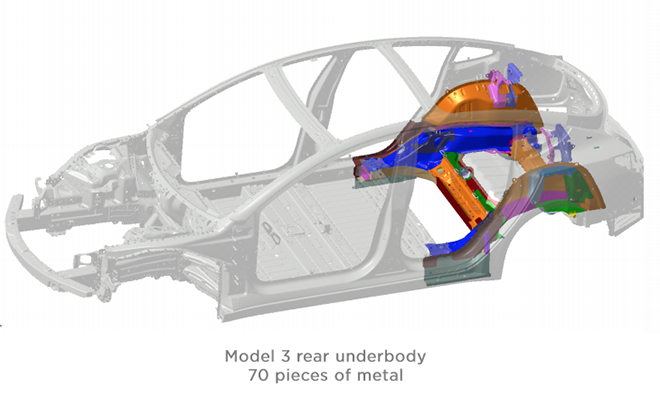
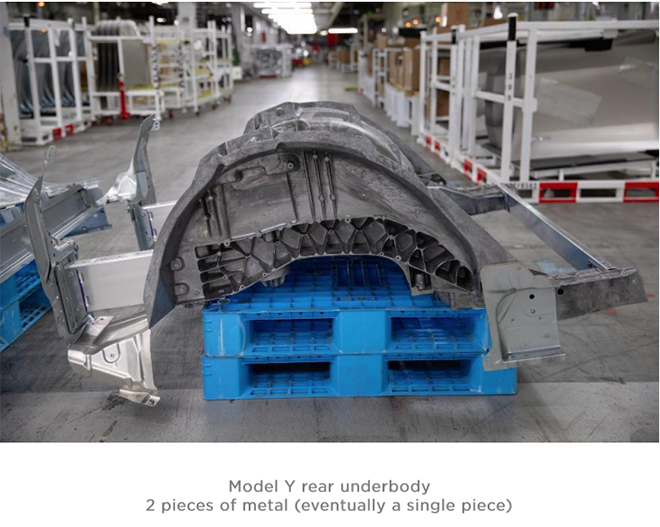
Tesla is constantly working to simplify the manufacturing process for its vehicles. Last year the company applied for a patent on a new casting machine that would be used to build Model Y. “When we get the big casting machine, it’ll go from 70 parts to 1 with a significant reduction in capital expenditure on all the robots to put those parts together,” said Elon Musk.

Now Tesla has released images of the results. Diagrams show Model 3’s underbody, which is made up of 70 stamped steel and aluminum parts, and Model Y’s underbody, which consists of just two huge hunks of cast aluminum. (Sandy Munro also gave us a look at the innovative new parts in his recent Model Y teardown.)

In the Q1 earnings conference call, Musk called the new casting procedure “revolutionary”—no overstatement, considering the amount of time and money it must save—and said that more advances are in store: “We are going to be making a single-piece casting later this year, meaning…the rear third of the body is cast as a single piece. There is no casting of the size and complexity that has ever been done before.”

Tesla plans eventually to use the same casting technology on its other vehicles—a change that will surely require a major revamping of the production line—but has not mentioned a timeline.

Source: Tesla, Electrek


source https://chargedevs.com/newswire/in-model-y-tesla-replaces-70-underbody-parts-with-one-casting/

Friday, 1 May 2020

Building a sustainable EV battery supply chain: New Report


The transition to EVs frequently raises questions about the sustainability of batteries, from mining impacts to vehicle carbon emissions. To address these questions, the Center for Law, Energy & the Environment (CLEE) and the Natural Resource Governance Institute (NRGI) are conducting a research initiative focused on identifying strategies to improve sustainability and governance across the EV battery supply chain. CLEE and NRGI convened stakeholders from the mining, battery manufacturing, automaker, and governance observer/advocate sectors, to develop policy and industry responses to human rights, environmental and other risks facing the supply chain.

As the first step in this initiative, CLEE and NRGI have prepared a background brief to address key questions such as:

  • What does the supply chain for EV batteries comprise?
  • How do carbon emissions from EVs compare to those from internal combustion engine (ICE) vehicles?
  • What are the most significant challenges associated with managing the mineral extraction processes necessary for the EV supply chain, and what sustainability and human rights initiatives apply to these challenges?

The brief includes a number of preliminary findings, such as:

  • The greenhouse gas emissions benefits of EVs are clear, and will grow as global electricity supplies become increasingly less carbon-intensive.
  • The supply chain is complex and subject to a number of potential bottlenecks where few countries or companies are responsible for dominant shares of production.
  • Various stages of the supply chain in locations around the world present sustainability risks, from low-level corruption to displacement of local populations, but these risks are not unique to EV mineral extraction—and a number of global initiatives are working to address them.
  • However, supply chain players will need to significantly improve coordination and data-sharing efforts to achieve long-term sustainability.

CLEE and NRGI will release a full report later this year building on these findings and offering policy recommendations to address key risks.

Source: UC Berkeley


source https://chargedevs.com/newswire/building-a-sustainable-ev-battery-supply-chain-new-report/

Promising lithium-sulfur active battery material made with low-cost liquid phase process

Sulfur

Scientists at the Toyohashi University of Technology have made an active sulfur material and carbon nanofiber (CNF) composite using a low-cost liquid phase process. Their paper, published in the American Chemical Society’s ACS Applied Energy Materials, claims that all-solid-state lithium-sulfur batteries using a sulfur-CNF composite material show higher discharge capacity and better cycle stability than lithium-ion batteries.

All-solid-state batteries have attracted attention as next-generation batteries because they have five times the potential energy density of conventional lithium-ion batteries. But because sulfur is an insulator, it must be provided with an ionic and electron-conductive path. To address this, the researchers synthesized cathode composites by combining a sulfur active material and carbon nanofiber (CNF) using an electrostatic assembly method, which can uniformly combine materials in a solution. The batteries showed high discharge capacity, even after repeated charge-discharge cycles.

Schematic images and electron microscope photograph of sulfur-carbon composites (upper). Schematic images and cycle characteristics of all-solid-state sulfur battery (lower).
(C) TOYOHASHI UNIVERSITY OF TECHNOLOGY. ALL RIGHTS RESERVED.

One of the paper’s co-authors, Professor Nguyen Huu Huy Phuc, explains: “Conventionally, sulfur-carbon composites were synthesized by mechanical mixing—liquid mixing using a special organic solvent and complicated methods—in which sulfur is combined with a porous carbon material with a high specific surface area. We focused on making a sulfur-carbon composite using a low-cost and simple electrostatic adsorption method which can uniformly combine nanomaterials.”

Source: Toyohashi University of Technology


source https://chargedevs.com/newswire/promising-lithium-sulfur-active-battery-materials-made-with-low-cost-liquid-phase-process/