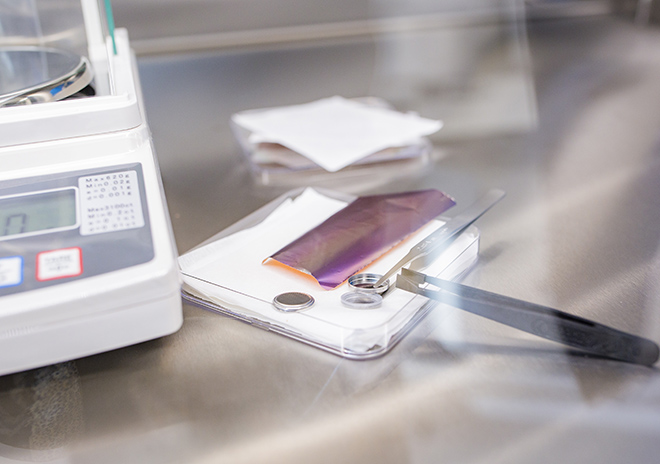
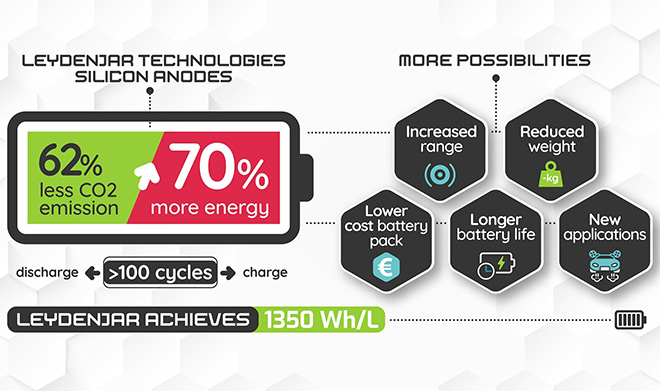
LeydenJar Technologies, a Dutch spinoff of the applied research institute TNO, has developed a new battery anode that’s made from 100% silicon. The company says this provides two key benefits: batteries with a 70% higher energy density (1,350 Wh/L) and 62% lower CO2 emissions than current models. The anode is ready for production, and LeydenJar is preparing to scale up its manufacturing capacity in the coming years—it says the new technology does not increase production costs and is a plug-in solution for existing battery gigafactories.
The company produced pouch cells using its new silicon anodes and commercially available battery materials, such as NMC 622 cathodes. According to LeydenJar, DNV GL confirmed that the cells delivered more than 100 cycles at a C/2 rate. CTO Yiseop Ahn expects to significantly improve cycle life performance.
Founder and Managing Director Christian Rood said, “Electric driving, more intelligent smartphones, electric flying…everything and everyone is waiting for better batteries. Our solution is smart and easily incorporated, and there’s no additional cost.”
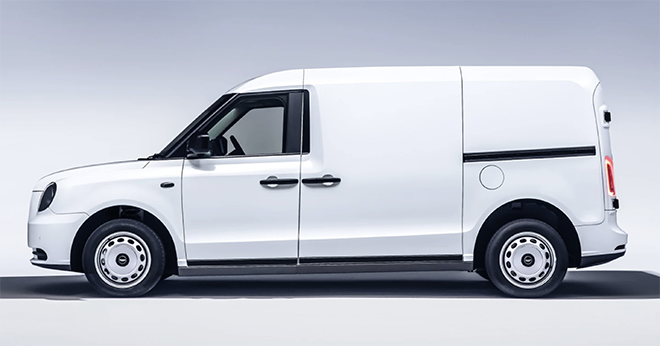
London Electric Vehicle Company (LEVC) has launched a new plug-in hybrid light commercial van that shares its distinctive styling with the iconic London black cab. LEVC’s VN5 van features a front end that’s similar to the company’s electric TX taxi, launched in 2018. The driver cabin, which is also shared with the TX, features an ergonomic workspace that’s been designed based on input from thousands of London cabbies.
The VN5 has been designed to operate in tight urban spaces—it has a turning circle of just 10.1 meters, a large side-loading door and a 60/40 split door at the rear. Electric range is “over 58 miles,” cargo capacity is 5.5 cubic meters, and gross payload is 830 kg.
Three VN5 variants are available—Business, City and Ultima. All VN5 models feature 50 kW DC rapid charging and 11 kW AC charging capability. City trim adds a heated windscreen, front and rear parking sensors, curtain airbags and Lane Departure Warning, while the flagship Ultima features a rear-view camera, luxury seats and 22 kW AC charging capability.
Six option packages are available. LEVC has also worked with a number of European convertors to ensure the VN5 can be equipped with roof racks, light bars and other bespoke modifications.
“We’ve applied our extensive knowledge from the taxi world to create a high quality, hard-working van with zero emissions and long-distance capability,” said LEVC CEO Joerg Hofmann. “As well as offering favourable operating benefits, VN5 fulfils the growing demand from both businesses and consumers for cleaner, more sustainable commercial vehicles.”
VN5 will be sold through LEVC’s dealer network, which will have 50 locations in the UK by the end of this year. In the UK, Contract Hire arrangements for business users will be offered through Lex Autolease. VN5 is expected to qualify for national incentive schemes such as the UK OLEV plug-in grant, which offers a discount of 20% off the purchase price, up to a maximum of £8,000.
The VN5 is now available for pre-order. Deliveries of right-hand-drive versions are expected to begin in Q4, and LHD models are to be available from March 2021.
A new report from The Brattle Group finds that EVs will be a major disruptor for the US electric power sector. The group’s economists predict that the number of EVs in the US will increase from 1.5 million in 2020 to 10-35 million by 2030. They estimate that the electric power sector will need to invest $75-125 billion by 2030 to serve 20 million EVs, including the deployment of 1-2 million public chargers.
20 million EVs will add 60-95 TWh of annual electricity demand and 10-20 GW of peak load, requiring 12-18 GW of renewable generation capacity.
Total investments will likely include $30-50 billion for generation and storage, $15-25 billion for transmission and distribution (T&D) upgrades, and $30-50 billion for EV chargers and customer-side infrastructure.
Fuel cost savings will be $12 billion/year, translating to an 8.6-year payback period for the investment. If the value of avoided greenhouse gas emissions is included at $50/ton, the payback period decreases to 7.2 years.
The batteries installed in 20 million EVs will have up to 1,600 GWh of electricity storage capacity. They could feed up to 300 GW of power back into the grid to help integrate renewables once large-scale vehicle-to-grid (V2G) operations are viable. This V2G storage capability vastly exceeds the grid’s current and projected storage capability.
The study notes that utilities are well-positioned to invest in a substantial portion of the infrastructure necessary to drive EV adoption and to help achieve the ambitious policy targets for electrification.
“Transportation electrification poses uncertainties for electric utilities, but also creates opportunities to drive accelerated decarbonization, manage grid reliability, improve asset utilization, and become more customer-centric organizations,” said study coauthor Sanem Sergici. “While this analysis focuses primarily on light-duty vehicles, electrification of commercial fleets and freight trucks will further magnify electrification-related opportunities.”
“While EVs and chargers are becoming more common in our everyday lives, the industry is really just seeing the tip of the iceberg when it comes to the impact that EVs will have on the grid,” said study coauthor Michael Hagerty. “System planners across the electricity supply chain need to better understand and prepare for the impacts of EVs, including the opportunities for EV participation in balancing the system.”
Demand for raw materials used in the production of EV batteries is expected to soar, and the UN trade body, UNCTAD, says the industry urgently needs to address the social and environmental impacts of the extraction of raw materials.
UNCTAD predicts that the market for EV batteries will grow from an estimated $7 billion to $58 billion by 2024. Some of the raw materials used in battery packs come from a small number of countries, which raises a number of concerns.
Two thirds of all cobalt production occurs in the Democratic Republic of the Congo (DRC). According to UNICEF, about 20 percent of cobalt supplied from the DRC comes from mines where human rights abuses have been reported, and up to 40,000 children work in dangerous conditions for meagre income.
In Chile, lithium mining uses nearly 65% of the water in the country’s Salar de Atamaca region, one of the driest desert areas in the world, to pump out brines from wells. This has forced local quinoa farmers and llama herders to abandon ancestral settlements, and has also contributed to landscape damage, soil contamination, groundwater depletion and pollution.
Noting that “the rise in demand for the strategic raw materials used to manufacture electric car batteries will open more trade opportunities for the countries that supply these materials,” UNCTAD’s Director of International Trade, Pamela Coke-Hamilton, proposed that these countries should “develop their capacity to move up the value chain.”
In the DRC, this would mean building processing plants and refineries that would add value and, potentially, jobs within the country. Currently, refining takes place in other countries, mainly Belgium, China, Finland, Norway and Zambia, which reap the economic benefit.
UNCTAD also recommends that the industry find ways to reduce its dependence on critical raw materials, and develop a recycling chain for spent batteries, measures that would help deal with the expected increase in demand, and also create new business opportunities.
Tesla’s mission has always been to advance the transition to electromobility, and Elon Musk has said many times that he’s open to licensing deals that would allow other automakers to use the company’s technology. As far as we know, only two major brands have ever taken Tesla up on the offer: back in the 2010s, Tesla briefly provided batteries for Daimler’s electric smart and B-Class Electric Drive, and for Toyota’s RAV4 EV. Both of these were compliance cars that the companies sold in low volumes and soon discontinued.
“The problem that we found with programs we did with Toyota and with Daimler was that they ended up being too small,” Elon Musk later said. “They basically— just calculated the amount they needed to keep the regulators happy and made the program as small as possible. We don’t want to do programs like that. We want to do programs that are going to change the world.”
Recently Musk made another appeal. In response to a Teslarati story about the German automakers, whose embarrassment at falling behind Tesla has become a common theme in the EV press, Musk tweeted: “Tesla is open to licensing software and supplying powertrains & batteries. We’re just trying to accelerate sustainable energy, not crush competitors!”
Asked if Autopilot was included in the offer, Musk replied, “Sure.”
There are many intriguing possibilities out there. As Teslarati pointed out, it’s an open secret that the German automakers are years behind Tesla in several key areas. Could licensing some of the Californians’ tech help them catch up? CNET retorted that things aren’t that simple in the auto industry. The VW Group and others have invested billions in their own EV tech. Throwing it out and trying to plug in Tesla’s software, battery packs or whatever might not end up saving them any time, but it would cost them plenty both in cash and reputation. The Germans are used to thinking of themselves as the masters of the automotive universe, and they want to meet Tesla as equals (at least), not as poor supplicants.
The idea of sharing the Supercharger network might present possibilities for mutual benefit. Der Spiegel recently reported that the German brands are struggling to handle the sudden surge in EV demand in Europe, and that a lack of charging infrastructure is part of the problem. (Tesla now has almost 5,000 Superchargers in 24 European countries, while the Ionity consortium has only 1,160 so far).
Making other EVs compatible with Superchargers probably wouldn’t present an insurmountable technical challenge, and it would go a long way toward winning over potential buyers who are still worried about charging. But would Tesla be willing to give up such a valuable competitive advantage for any reasonable price?
Who knows? Like Musk, we just want to see everyone driving EVs, and if the legacy brands could find ways to cooperate with Tesla to get the latest and greatest tech out there more quickly, we’d be all for it. But for a number of reasons, we don’t expect to see anything of the kind happen any time soon.
Volvo Trucks North America has deployed its first pilot VNR Electric truck in Southern California as part of the Volvo LIGHTS (Low Impact Green Heavy Transport Solutions) project—a collaboration with the South Coast Air Quality Management District and 13 other organizations to develop a blueprint to scale up the adoption of battery-electric trucks.
The first e-truck will operate at Volvo’s TEC Equipment dealership in Fontana, California, transporting parts between dealerships in Fontana and La Mirada. TEC’s Fontana facility has two 50 kW chargers inside its truck maintenance bays, as well as a 150 kW charger located outside to enable fleet customers to fast charge.
As part of the LIGHTS project, two local fleet operators—NFI Industries and Dependable Supply Chain Services—will also begin demonstrating VNR e-trucks on regional routes later this summer. Starting in 2021, Southern California businesses will be able to lease Volvo VNR Electric trucks from TEC Equipment to gain experience with these trucks in their fleet operations.
“Working with our dealership to pilot the first Volvo VNR Electric in real-world applications is an exciting step toward our plans to commercialize these zero-emission trucks in North America this fall,” said Peter Voorhoeve, President of Volvo Trucks North America. “The all-electric Volvo VNR will become the ideal truck model for short- and regional-haul applications, such as urban distribution and drayage.”
“Everyone on my team that has had an opportunity to drive the Volvo VNR Electric has been surprised by how smooth the truck operates,” said Mike Reardon, GM of TEC Equipment’s Fontana dealership. “Our parts delivery driver loves taking it out, saying it is very quiet and comfortable in the cab and has great power at take-off.”
The LIGHTS project also includes partnerships with Rio Hondo College and San Bernardino Valley College to create EV repair and service technician programs, as well as a training program with fire departments to ensure that the region’s first responders are prepared for accidents involving heavy-duty BEVs.
In these troubled days, the world is divided into two hostile camps—each faction demonizes the other, and refuses even to listen to the other side’s arguments. Families have been torn apart, and sometimes it seems people are about to come to physical violence, or even block former Facebook friends.
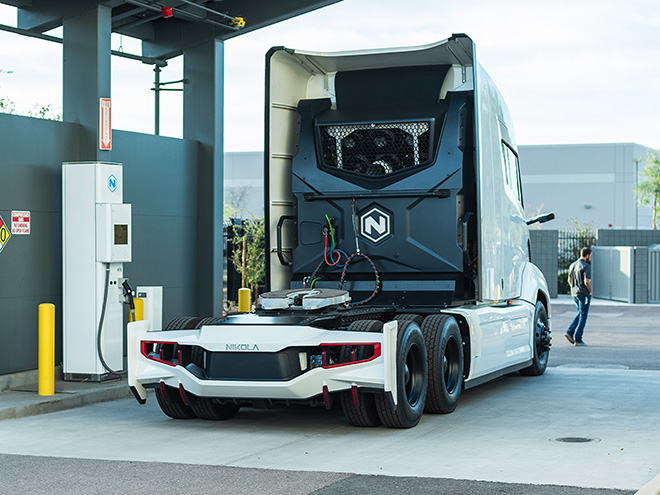
But what if the batteries-vs-hydrogen debate is based on a false choice? What if both technologies have important niches to fill in the zero-emissions ecosystem? Nikola founder Trevor Milton had plenty to say on this topic in a lengthy interview on This Week In Startups.
Host Jason asked what must seem an obvious question: Why focus on hydrogen instead of batteries? Tesla, which famously wants nothing to do with hydrogen, is the stock market darling of the year (Jason’s a Tesla owner and obviously a fan), and the legacy automakers have been abandoning hydrogen one by one. Is Nikola swimming against the tide?
This may be a case of asking the wrong question. Trevor Milton clarifies that Nikola plans to produce both battery-electric and fuel cell vehicles. “There are two different markets,” says he. “A lot of people think hydrogen competes with batteries—it doesn’t. [A battery powertrain] works really good up to about 300 miles. Over 300 miles hydrogen makes much more sense, because of weight. The weight is everything in trucking.” As Milton explains, more battery weight means less payload, and thus less revenue.
Milton acknowledges that “hydrogen does not make sense in every situation—it’s only a very narrow window.” Inside that narrow window is long-haul trucking, which is a trillion-dollar industry.
Nikola’s business model is not built around selling trucks—rather, it involves selling transportation on a pay-per-mile basis. The idea is to provide a package of vehicles and infrastructure that’s tailored to serve particular trucking routes. Nikola will provide the trucks, the fueling stations (which will be optimally sited for each particular customer’s needs) and the hydrogen, and the customer will pay “about a dollar a mile.”
Milton understands as well as anyone that hydrogen doesn’t make sense for passenger cars: “Cars are a terrible idea a lot of times with hydrogen,” he says, adding that automakers that have been trying to sell fuel cell cars “went after the wrong market.” It’s a question of the right storage medium for the right type of vehicle. “In cars, batteries are awesome…when you get into cars and light-duty [vehicles], batteries are the best thing. Heavy-duty—hydrogen’s the best thing.”
Milton covered a lot more ground in this interview: why trucking companies are phasing out diesel, the challenge of competing against Tesla, the pros and cons of building components in-house vs outsourcing, and Nikola’s future plans for consumer pickup trucks.
There’s plenty of material worth watching here, but for us, Milton’s explanation of the respective strengths of batteries and fuel cells is a highly timely highlight. Those who are hoping to see a battery-vs-hydrogen smackdown (In this corner, the debunker of fool cells, Elon Musk!) may be disappointed, but, in the EV realm, peaceful coexistence probably makes a lot more sense.