Volkswagen Group Components and startup Shanghai DU-POWER New Energy have formed a joint venture to produce “flexible quick charging stations” in China. The two companies will each own 50% of the JV, which will be located in the Suzhou Wuzhong Development Zone, near Shanghai.
Series production is scheduled to start in the second half of 2020. V
As previously announced, the new flexible quick charging station will also be produced at VW’s Hannover site, beginning this year.
The flexible quick charging station offers charging levels of up to 150 kW. It’s compact, and is designed to be installed almost anywhere it’s needed. The built-in battery pack can store a buffer of energy, so it can be disconnected from the grid. The charging station is also designed to be able to use second-life batteries from EVs.
“The planned joint venture with DU-POWER represents a significant milestone as we continue to make progress along the path to electric mobility,” said Thomas Schmall, CEO of Volkswagen Group Components. “The innovative design of our flexible quick charging station has huge potential in China.”
“The electrification of the global automotive industry is a megatrend,” said Yong Kang, CEO of Shanghai DU-POWER. “As an ambitious high-tech company with a competent technical development core, we will work with Volkswagen to create a solid foundation to support the success of electric vehicles. The partnership for establishing a joint venture in China enables us to collaborate closely on the technical aspects of the project to provide flexible, reliable and efficient solutions.”
Schleuniger Global recently introduced CrimpCenter 64 SP, its latest automatic crimping machine. The company says that the new product delivers 8 to 14 percent faster production compared to its predecessor.
The new CrimpCenter 64 SP provides an array of features, including:
Application-specific default values for process parameters
Dual ToolingShuttle quick-change system
Automatic pneumatic pressure control of feeding belts and gripper systems
A straightening unit
A new roller design for very thin cables
A new deposit gripper system
Integrated crimp-force monitoring for multiple stamped terminals
A split-cycle function
The CrimpCenter 64 SP offers several quality-monitoring options, such as SmartDetect, WireCam, material change detection, PullTester 320, crimp-height measurement, and ErrorExpert software.
Enovix Corporation has secured an additional $45 million to produce and commercialize its 3D Silicon Lithium-ion Battery. Enovix CEO Harrold Rust said, “Anchoring the round is a $25-million strategic investment from a leading California technology company. Present investors have added $10 million, and customers have contracted $10 million to develop batteries for specific products and to reserve production capacity.”
Enovix will use the bulk of the funds to complete its Fremont, California high-volume battery production facility, where about 75% of the equipment and processes are identical to those used in standard pouch battery manufacturing. Enovix has developed proprietary electrode laser patterning and high-speed stacking tools that replace the standard electrode winding process to increase production line MWh capacity by 30%. “We initially attracted customers when we sampled cells about a year ago with energy density over 900 Wh/l and full-depth of discharge cycle life over 500,” said Rust. “As customers and investors visited our production site and saw our proprietary electrode laser patterning and high-speed stacking tools in action, their confidence in our production capability was sufficient to generate revenue and secure additional funding.” The facility is expected to produce batteries for delivery in late 2020 and to reach a run rate of 8 million units per year as it ramps in 2021 and 2022.
Enovix has also signed new agreements with two additional portable electronics companies. The company now has agreements with four customers to develop and produce silicon-anode lithium-ion batteries for portable electronic devices, worth an anticipated $250 million in annual revenue once fully ramped. Enovix is now working with international automobile manufacturers to develop its patented battery technology for the EV market, where the company expects to supply batteries within five years.
Why shouldn’t there be a day to honor Elon Musk? If static electricity and bubble wrap are entitled to commemorations on the calendar (January 9 and 27, respectively), surely the visionary behind Tesla, SpaceX, PayPal and other high-tech ventures deserves a day.
That’s the question that Tesla pundit and superfan Anuarbek Imanbaev asked a group of his colleagues, and here’s the result of their conversation: April 20 will henceforth be celebrated as Elon Musk Day.
The festivities will be streamed live on the Third Row Tesla podcast and other online channels, but the main event is to encourage as many people as possible to tell their stories of how they have been influenced by Elon Musk. “The whole idea of Elon Musk Day is that people will go on social media, whatever platforms they’re on, and put up a post sharing either how one of Elon’s products or companies have changed their lives, and/or how they were inspired by Elon Musk that’s resulted in something they’re doing now,” Anuarbek explains.
“All the great people—we always appreciate them when it’s too late,” says Anuarbek. “Even Nikola Tesla, for that matter—he created so many great inventions, but he died broke in an apartment in New York by himself. Why are we waiting? Let’s do it now.”
“It’s just about showing appreciation,” Anuarbek continues. “I want Elon to know that there are so many people that are proud of him, that are backing him up, and want to see him succeed. And it’s not only about Elon—there are probably 80,000 people working for all his companies. I want all of them to know that we appreciate them as well. They’re inspired by the work, they believe in the mission.”
Anuarbek Imanbaev is familiar to Tesla followers as the reformed oil and gas exec who played an important role in bringing Tesla Superchargers to the Central Asian nation of Kazakhstan. His partners in establishing Elon Musk Day are: Eli Burton, publisher of the graphic novel The Adventures of Starman and co-producer of the Tesla Geeks Show podcast; Sofiaan Fraval, host of the Third Row Tesla podcast; and Ross Gerber, a Tesla investor and a frequent defender of the company on TV and online media. (In his latest appearance, Gerber argued that the company is in a better position than other automakers to weather the current health crisis.)
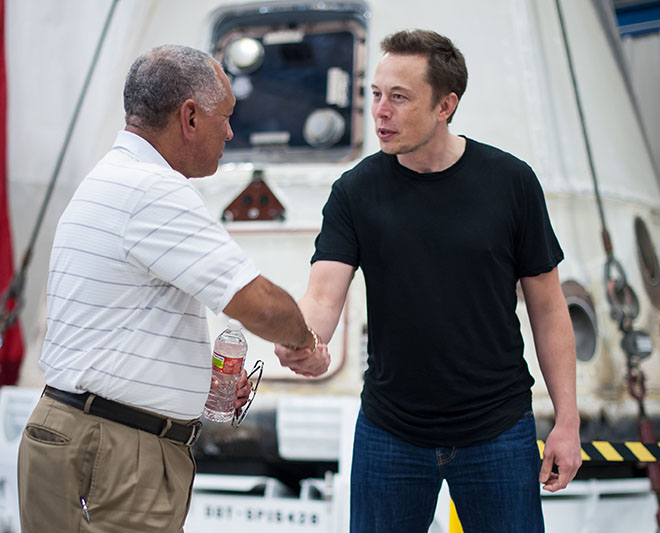
NASA Administrator Charles Bolden congratulates SpaceX CEO and Chief Designer Elon Musk following the first successful mission by a private company to carry supplies to the International Space Station. Photo Credit: (NASA/Bill Ingalls)
These tireless Tesla supporters will be happy to tell you in detail about how the Iron Man has influenced them. However, Elon Musk Day is not intended as a spectator event. You are invited to participate by tweeting, posting, podcasting or pasting on a pigeon your own story about how Tesla, SpaceX, PayPal (or Hyperloop, the Boring Company, flamethrowers or whatever) has inspired you, and influenced your own work (or play). Use the hashtag #ElonMuskDay to help spread the word.
Here’s my story: I began my journalism career chronicling the rise of the internet in the 1990s, and it was exhilarating to write about new technology that we knew was destined to radically remake society. When I was invited to join Charged in 2012, I saw a chance to once again be in the middle of a historic technological transformation—and this time, the new tech serves a noble cause: improving human health and preserving our environment.
I’ve been writing about the e-mobility transition ever since, and although I write about all things electric, Tesla has always been at the center of the action. Tesla is the trendsetter that generates public interest in EVs, and the goad that forces the recalcitrant legacy automakers to continue developing their own EVs. The company’s influence can hardly be overstated: if Tesla didn’t exist, there would probably be no viable passenger EVs on the market today (and I’d be writing about organic vegetables or some equally exciting topic).
In addition to print and online articles for Charged, I write Tesla-specific articles for the EVannex blog, and I’ve written a book about Tesla which is now coming up on its fourth edition, and has been translated into three other languages. So I’ve derived a bit of money, and a tremendous amount of personal satisfaction, from the revolution that Tesla set in motion.
NASA holds a slew of patents on EV-related technology, including battery management systems, ultracapacitors, modular robotic vehicles, composite materials and more.
Did you know the agency is licensing the technologies to automotive companies through a simple online procedure?
Manufacturers can search NASA’s database of automotive technology, apply for a license by submitting a commercialization plan, negotiate terms with a NASA licensing manager, and sign the agreement.
The scale of things in China tends to blow Western minds. Swiss electronics giant ABB recently supplied 1,600 AC charging stations to a single housing development near Qingdao, in Shandong province. ABB says this is its largest AC charger order to date.
ABB’s EVinn AC charger includes capabilities such as digital billing, remote monitoring and maintenance. The ability to remotely schedule charging times in advance allows residents to take advantage of off-peak electricity prices, reducing charging costs by up to 35 percent.
The Ao Zheng Cheng Yuan project will include some 2,480 homes, including 260 “boutique residences.” These will also feature ABB’s i-bus KNX smart home solution, which allows automated control of lighting, heating, AC and other functions.
“We wanted to offer our residents an intelligent living space with the option to reduce their impact on the environment by driving in a more sustainable way,” said Mr. Liu, General Manager of Linyi Ao Zheng Real Estate Development. “By deploying ABB’s industry leading smart home solutions and installing its EVinn AC chargers, we are giving residents exactly that option. This combination of solutions represents an innovative concept across China; a high-end and fully smart eco-community which we hope will serve as an example for future Chinese residential developments.”
If a malfunction occurs in an EV battery, rapid venting is required in order to reduce the pressure in the affected battery segment. KACO Sealing Systems has developed a quick deflation solution for EV battery modules, centered around a piston that tightly seals the exhaust port after venting.
KACO’s Quick Deflation is designed so that a pressure compensation element can also be integrated, ensuring both regular pressure compensation and emergency venting in one product. Various locking mechanisms (magnetic and/or spring-loaded) are available to meet customer requirements.
KACO’s VP of R&D Andreas Genesius is enthusiastic about the new solution: “With the development of Quick Deflation for battery systems, KACO offers a further modular product group in the application area of ventilation in the drive train. By using state-of-the-art calculation programs, we can design venting caps and quick vents with regard to closing and opening pressures as well as required flow volumes for specific applications.”