Monday, 20 July 2020

Design guidelines for wire or ribbon bonding of cylindrical cells in battery packs


Sponsored by Hesse Mechatronics

By Mike McKeown and Dr. Dirk Siepe, Hesse Mechatronics

Wire bonding cylindrical battery packs is becoming more mainstream in the alternative energy market these days. This article will review the design guidelines for how to successfully implement a wire or ribbon bonding process for battery packs using cylindrical lithium-ion cells. It will involve everything between the battery pack housing to the cylindrical cell itself.

At the present time, there are a handful of methods of interconnecting cylindrical cells to the busbar. Resistance welding, spot welding, laser welding and wire bonding are the more common interconnection methods. Wire bonding utilizes ultrasonic energy to have the wire or ribbon form an atomic bond with the surface as the wire and surface share electrons. The aluminum oxide, which is self-limiting, actually helps optimize the wire bonding process as the ultrasonic process removes the oxide layer and exposes virgin aluminum to enable the transfer of valence electrons.

For wire bonding battery packs, Hesse prefers to bond onto the cell first and then up to the busbar. This is done for practical purposes as if for some reason you encounter a non-stick on the cell, you could easily rework it. We normally use a back-cut arrangement where the cutter blade is positioned behind the bond tool to enable the most clearance for the bond head.
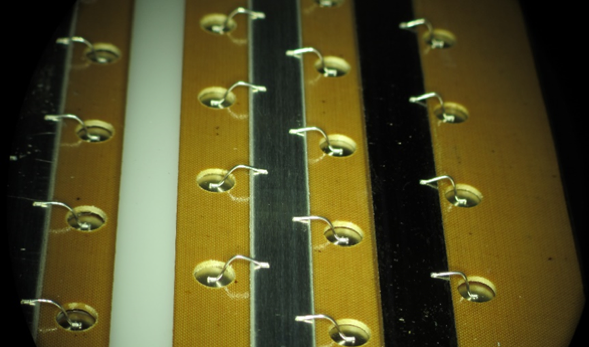
Wire bonded battery pack for Formula SAE Race Car.
Photo courtesy of Purdue University Race Team.

Cell and Busbar Metallization

Almost all of the cylindrical cells have an electrolytic nickel over stainless steel metallization. For wire bonding with aluminum wire, it would be ideal if the metal can was aluminum as a mono-metallic system is optimum. As for the busbar material, it is best if it is also aluminum. We have found that Al1145 is the best metal. A thickness of 1-2mm should be sufficient, but it is not recommended to make the busbar too thick as this could inhibit bond head clearance in relation to the top of the cylindrical cell. We have also found success wire bonding to other Al such as 3003, 5052 6061 but one needs to review the technical specifications of these aluminum to ensure resistivity, conductivity, etc. If you do use a Cu busbar, then you need to plate it with ENIG (Electroless Nickel Immersion Gold) or ENEPIG (Electroless Nickel Electroless Palladium Immersion Gold). These are off-the-shelf chemistries that are excellent for wire bonding. Refer to the IPC specifications for 4556 and 4552. The important aspect is to request a “mid-phos” bath of 4-11% as this is ideal for wire bonding. All busbar material should be half-hard temper. If you must wire bond directly to a Cu busbar, then you will need to clean the Cu prior to wire bonding.

Busbar Attachment to Matrix

There are numerous methods to attach the busbar to the cell carrier. Some prefer to use an adhesive or epoxy method. The main issue to be careful of is to dispense the adhesive material beneath the busbar area where wire bonding will be done. We have not had much success with heat-staking the busbar as the heat-stake interconnection could become weak over time and cause the wire bond heels to fail prematurely due to excessive lateral movement. We have found that screws that extend through the battery pack have the best wire bond performance. In order to achieve this, the screws need to be evenly placed throughout the busbar. Do not just put screws on the ends of the busbar as you will encounter camber issues. Refer to Figure 1 to see the position of these screws. The key item with the busbar is that it cannot move in X, Y or Z directions. The busbar has to be rigidly held to the cell carrier to ensure optimum wire bonding.

Bonding on the Negative

Wire bonding onto the negative terminal of a cylindrical cell is doable. Hesse utilizes unique pattern recognition algorithms to locate the negative section of the cell prior to wire bonding to ensure proper wire placement. If you do shear testing, remember to shear the bond in the direction away from the positive to avoid any short circuiting.
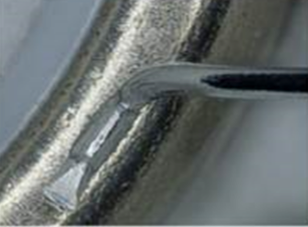
Wire bond on the negative terminal of a cylindrical cell

Process Guidelines

Cleanliness: Some companies do not have to clean their cylindrical cells prior to wire bonding but if needed, one could use a manual process of using a wire with IPA (Isopropyl Alcohol). For more thorough cleaning, you could evaluate laser ablation or CO2 cleaning. A mechanical scrubbing process is also an option but be careful not to remove the nickel-plated layer and you have to vacuum the dust particles.

Bonding Wire: The main wire suppliers all recommend a less ductile wire. You do not want to use too soft a bonding wire in relation to the harder electrolytic nickel surface of the cylindrical cell.

Fixturing: It is imperative that the battery pack is firmly held in place on the wire bonder’s working table. Just as it mentioned earlier in this article that the busbar needs to be rigidly held in place within the matrix, the entire battery pack cannot move during the wire bonding process. Any movement could inhibit wire bond quality.

Design Review: It is important to do a design review with the wire bonder company to ensure clearances are addressed with 3D models of the wire bond head.

Taguchi Techniques: We have found that by using a L9 Orthogonal Array could help get you an initial wire bond parameter window. There are more advanced Taguchi arrays that could then be utilized to further explore and statistically test out your wire bond parameters.

Wire Bond Quality: Hesse prefers to utilize the German Welding Specification, DVS 2811 Test Procedures for Wire Bonded Joints, for setting up wire bond quality criteria in regards to pull and shear testing and visual aspects.
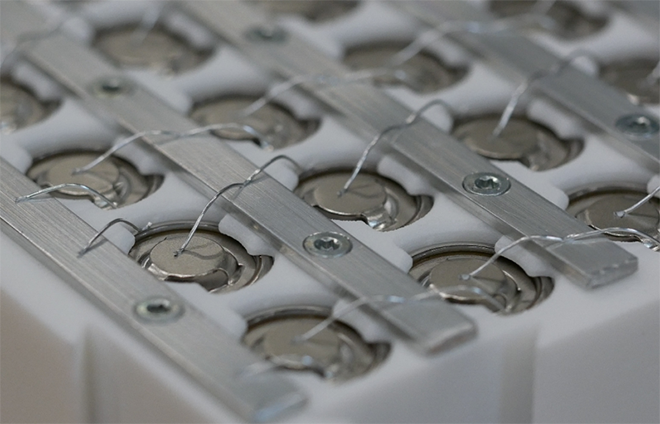
Hesse customer solutions battery pack

Wire bonding of battery packs for cylindrical cells can be easily implemented if these design guidelines are followed.  Getting from design to production would be easier and resulting in higher quality yields will also be achievable.

Hesse Mechatronics is a manufacturer of wire, ribbon bonders and smart welders. For more information, please contact michael.mckeown@hesse-mechatronics.com


source https://chargedevs.com/newswire/design-guidelines-for-wire-or-ribbon-bonding-of-cylindrical-cells-in-battery-packs/


Lightning Systems debuts new electric powertrain for Ford F-550 Chassis Cab


Colorado-based Lightning Systems has launched a new all-electric powertrain for the popular Ford F-550 Chassis Cab, which can be used for shuttle buses, delivery trucks and many other specialty vehicles.

The new Lightning Electric Ford F-550 will be available in gross vehicle weight ratings (GVWR) of 17,500 to 19,500 pounds. The company is now accepting orders from fleet customers.

The new model features a liquid-cooled battery pack that delivers a range of “more than 100 miles, depending on equipment configuration, payload, route, weather, and driver,” and DC fast charging. Peak power is 180 kW (241 hp), torque is rated at 1,100 Nm (881 lb-ft), and top speed is 65 mph. The powertrain comes with a five-year, 60,000-mile warranty. Maintenance is performed by certified local service providers.

Lightning’s electric powertrain can also be used to convert existing trucks and shuttle buses.

The optional Lightning Analytics package is a cloud-based analytics system that provides real-time information for fleets, including predictive maintenance, route scoring, range analysis, driver behavior and geofencing.

All Lightning Systems vehicles are eligible for funding from the California Air Resources Board’s Hybrid and Zero Emission Truck and Bus Voucher Incentive Project (HVIP), which can reduce the upfront cost by 40 to 70%. Some other states also have incentive programs available.

“As a result of our modular and flexible battery and powertrain design, the Lightning F-550, like all of our platforms, supports a wide array of aftermarket solutions from leading Ford upfitters, including rear air conditioning for buses, rear heating, wheelchair lifts, cargo lifts, boxes, tow truck accessories, and refrigeration units,” said Lightning CEO Tim Reeser.

“One of the advantages to working with Lightning Systems is our willingness and ability to structure solutions specific to a fleet’s needs,” said Director of Business Development Nick Bettis. “The F-550 is an important addition to our product mix that enables us to offer electric trucks and buses from Class 3 to Class 8. Couple that with our complete suite of charging solutions, and we can address a fleet’s electrification needs from cradle to grave.”

Source: Lightning Systems


source https://chargedevs.com/newswire/lightning-systems-debuts-new-electric-powertrain-for-ford-f-550-chassis-cab/

TE Connectivity introduces high-voltage terminal and connector kits for EVs


TE Connectivity’s new EV solutions kits contain all of the company’s high-voltage terminals and connectors needed to create an assembly, now in a single package.

Kits are available for AMP+ HVA 280, AMP+ HVA 630, AMP+ HVP 800, AMP+ HVP 1100, and AMP+ IPT solutions designed for high-voltage EV applications.

“To make ordering and assembly easy, we are now offering these kits for high-voltage terminals and connectors,” said Product Manager Mike Brenner. “The hybrid and electric mobility solutions kits offer design engineers all of TE’s reliable parts needed for assembly in one package so they don’t have to worry about missing any parts or have to hassle with any order quantities.”

AMP+ HVA 280 finger-proof, touch-safe, two- or three-position low-medium current connectors and headers can be utilized with multi-core or individually shielded wire and include a discrete header design with a two-stage floating latch. The connector system also provides multiple latching options and an integrated internal HVIL.

AMP+ HVA 630 touch-safe two-, three-, four- and five-position low-medium current connectors and headers are designed to meet AK 4.3.3, LV215-1 specifications, and feature CPA (Connector Position Assurance). The AMP+ connectors and headers can carry up to 40 A at 140° C, and will accommodate 4-6 mm2 multicore wires. The shielded and sealed two-position connectors are designed for high-voltage onboard chargers. The five-position connectors allow three-phase charging currents up to 32 A for maximum charging capacity with a necessary mating force below 70 N. The package includes an integrated HVIL.

The touch-proof one-, two- or three-position high current connectors and headers found in the AMP+ HVP 800 kits are designed to meet AK 4.3.3, LV215-1 specifications. They can handle currents up to 200 A at 85° C, depending on wire cross-section. An integrated internal HVIL with multiple routing options is included, as well as a lever for low insertion force.

AMP+ HVP 1100 finger-proof, touch-safe, one-position high-current connectors and headers have a current-carrying capability up to 300 A at 85° C and 70 mm2. The system provides an integrated internal HVIL. 

Finally, TE’s AMP+ IPT shielded ring tongue, available in one-, two- or three-pole housings, provides 360-degree EMC shielding and wire-to-device capabilities. The screwed ring tongue can be applied on different length cables, according to the needs of the customer.

Source: TE Connectivity


source https://chargedevs.com/newswire/te-connectivity-introduces-high-voltage-terminal-and-connector-kits-for-evs/

Saturday, 18 July 2020

Documentary offers some new footage from Tesla’s Gigafactory (but you might want to mute the sound)

Tesla Batteries 18650 Li-ion Cells

A new documentary segment from Discovery’s Science Channel offers a rare, brief look inside Tesla’s Gigafactory 1 in Nevada. The 10-minute segment, part of an episode of the Super Factories series, features a bit of new footage from inside the Gigafactory, where few mortals have been permitted to tread.

Highlights include some cool shots of robots assembling battery packs, and comments by VP of Operations Chris Lister about the robot/human balance on the production line.

However, as numerous viewers quickly pointed out, the segment is poorly written and carelessly edited. The problems begin in the opening sequence, as the voiceover talks about Model 3 over footage of Models S and X, and refers to Tesla’s induction motor (Models S and X use induction motors, but Model 3 uses a permanent magnet motor).

Throughout the piece, the narrator incorrectly refers to the Model 3 as “the M3” (the M3 was a model from BMW). [Note to fellow journalists: It’s important to say, and spell, the names of companies and products exactly the way the company does—it’s not alright to make up your own versions.]

There are other similar inaccuracies, as well as grammatical errors and poor language. Furthermore, while the couple of minutes of new footage are worth watching, the rest of the show is what you might call boilerplate—stock B-roll footage of Tesla’s vehicles and the exterior of the Gig, and talking heads making comments that seem to be aimed at viewers who’ve never heard of an electric car before.

These weaknesses may annoy Tesla fans and pedantic journalists, but the producers made another gaffe that seems to have caused consternation at Tesla’s battery partner, Panasonic (which was not mentioned in the segment). The program reports that the Gigafactory produces “13 million individual battery cells per day.” However, a spokesperson for Panasonic told Electrek that this figure is not correct. The battery-maker declined to confirm the current cell production capacity, for “competitive reasons.” However, Electrek’s Fred Lambert noted that the most recently disclosed production figure was 54 GWh of battery cells per year, which would translate to approximately 8 million cells per day.

[Second note to fellow journalists: Companies tend to be sensitive about production figures, as they represent important financial information, which is relied on by investors and others. If you’re going to report them, you need to double-check that they’re accurate.]

Sources: The Science Channel, Electrek


source https://chargedevs.com/newswire/documentary-offers-some-new-footage-from-teslas-gigafactory-but-you-might-want-to-mute-the-sound/

Friday, 17 July 2020

Market report: EV batteries and battery materials in the first half of 2020 (free webcast)


Adamas Intelligence—the developer of a web-based platform that helps users track monthly deployment of battery materials, battery capacity, battery chemistries and cell suppliers—will provide an informative overview of the EV battery market in the past half-year at the Charged Virtual Conference on EV Engineering.

In a new webcast session announced this week, Alla Kolesnikova, Head of Data and Analytics, will discuss the global EV market’s performance in 2020 H1 and its implications on the ever-evolving battery and battery materials supply chains.

Register to watch the free webcast here.

In addition to battery material topics, the Charged Virtual Conference will cover battery systems engineering, motor design and manufacturing, power electronics design and manufacturing, testing, powertrains, thermal management, circuit protection, wire & cable, and more. New sessions announced include:

  • Battery Systems For The Heavy-Duty Market: Designing, Ruggedizing, Testing, And Manufacturing
  • Recovering Usable Battery-Grade Materials From Shredded Li-Ion Cells
  • Potting EV/HEV Motors
  • Measuring Torque Ripple And Its Effects On Electric Power
  • Developing And Testing The BMS For A New EV Program

Learn more.


source https://chargedevs.com/newswire/market-report-ev-batteries-and-battery-materials-in-the-first-half-of-2020-free-webcast/

BMW expands E-drive production capacity


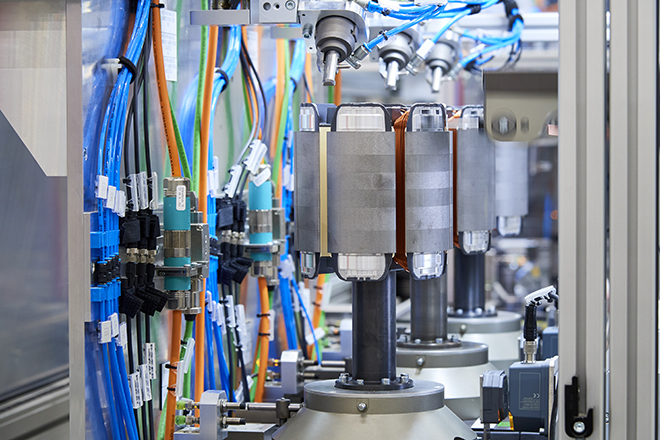
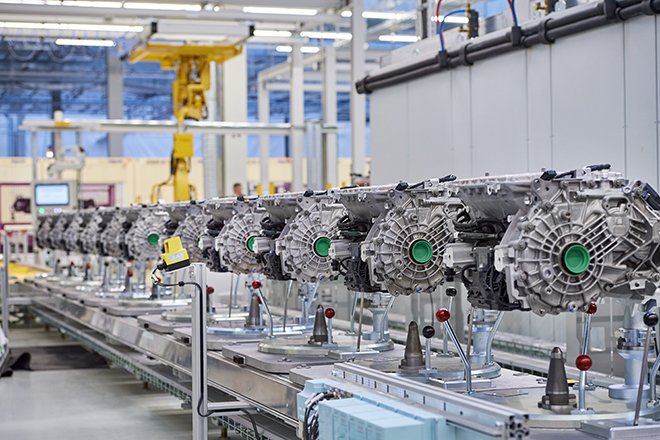
At its largest European manufacturing location in Dingolfing, Germany, BMW recently opened the Competence Centre for E-Drive Production. Having produced electric powertrain components in Dingolfing since 2013, the BMW Group is now expanding its capacity.

Bavarian Minister-President Markus Söder and Chairman of the Board Oliver Zipse symbolically launched the production of the new, highly integrated BMW e-drive, which combines the electric motor, transmission and power electronics in a central housing. The new generation of the BMW e-drive will be used for the first time in the new BMW iX3, which will go into production in China in late summer.

At the Competence Centre in Dingolfing, the BMW Group will produce electric powertrain components such as battery modules, high-voltage batteries and electric motors on eight production lines. Over the coming years, the company will set up four additional lines.

Chairman Zipse said, “By 2022, in Dingolfing alone, we will be able to produce e-drives for more than half a million EVs per year. At the same time, we will produce a mix of fully-electric vehicles, plug-in hybrids and models with a combustion engine on a single line, as required by demand.”

In the next few years, the Competence Centre’s production area will be expanded to ten times the original size: from 8,000 square meters in 2015 to 80,000. The number of employees will also be increased. In the first half of 2020 alone, the workforce grew from 600 to 1,000. Up to 2,000 employees will work in the production of e-drives at the Dingolfing location in the medium term.

“Our unique expertise in producing high-voltage batteries and electric motors ensures our technology is always state of the art, and we are able to ramp up production quickly and systematically in line with demand,” said Michael Nikolaides, head of Planning and Production Engines and E-Drives. A quarter of BMW Group vehicles sold in Europe should have an electric drivetrain by 2021; a third in 2025 and half in 2030. By 2023, the BMW Group will offer its customers no fewer than 25 electrified models, around half of them with pure electric drivetrains.

On the same day as the official opening, the Competence Centre also began production of the fifth-generation electric drivetrain. This highly integrated electric powertrain component combines the electric motor, transmission and power electronics in one housing. According to BMW, rare earth materials are no longer required.

Source: BMW


source https://chargedevs.com/newswire/bmw-expands-e-drive-production-capacity/

Buick launches Velite 6 PHEV in China


China is Buick’s largest market, and the brand seems to be GM’s chosen channel to introduce its new energy vehicles. Buick offers a wide range of electrified models, from 48 V mild-hybrids to pure EVs, in China. Last October, Buick launched the Velite 6 Plus, an EV with a range of 255 miles.

Now Buick has added the Velite 6 PHEV to its NEV lineup.

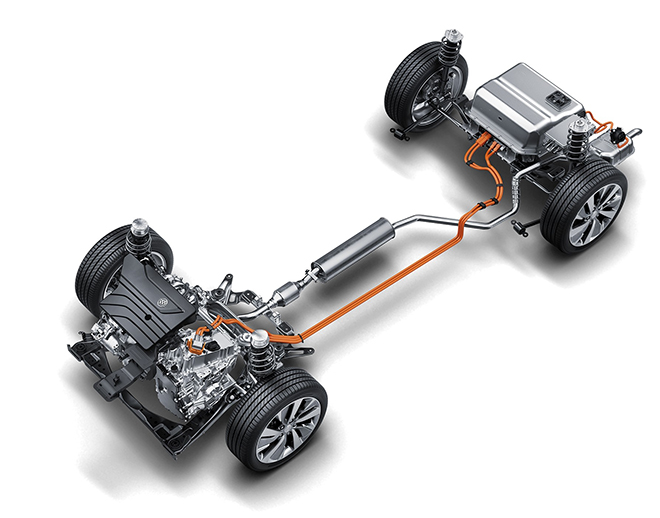
The Velite 6 PHEV is powered by Buick’s eMotion electric drive technology. It offers an electric range of 60 km. Dual electric motors work with a 1.5-liter four-cylinder engine and a battery pack from LG.

“Leveraging cutting-edge plug-in hybrid technology, the VELITE 6 will offer no compromises in vehicle performance or driving range, making it an ideal option for both daily commuting and long-distance travelling,” said Molly Peck, Executive Director of Buick Sales and Marketing at SAIC-GM.

Source: GM via Green Car Congress


source https://chargedevs.com/newswire/buick-launches-velite-6-phev-in-china/